When software founders and product managers look at automated testing, they often view it as a one-time insurance policy: you build a test, it checks your code, and you deploy.
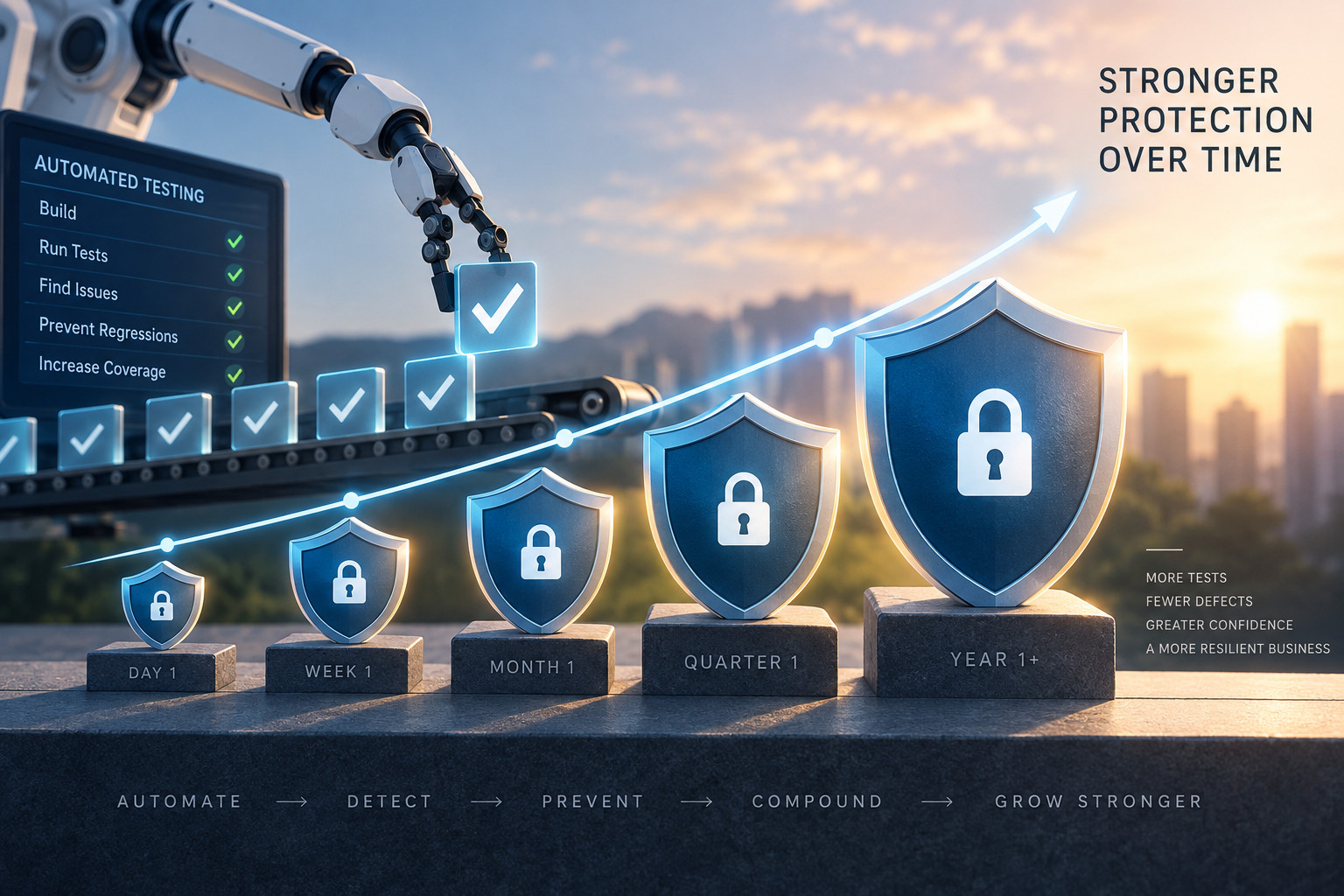
But true automation doesn't operate on a flat line. It operates on compound interest.
Every week your automated test suite exists, it expands. It absorbs new user workflows, mimics real customer journeys, and locks down past vulnerabilities. Over time, the return on your investment grows exponentially, transforming your testing pipeline from a basic verification method into your company's greatest competitive asset.
Here is exactly how the compound effect of automation plays out over time, and what happens to your development cycle when you let it build.
Phase 1: The Immediate Payoff (Day 1 to 30)
Many software teams assume they won't see results from automation until a massive suite is fully coded. In reality, the first massive spike in ROI happens right during development.
When QA engineers sit down to build your initial test suites, they aren't just writing script—they are auditing your software in extreme detail. Practice shows that a significant percentage of hidden, lingering bugs are caught during the initial setup phase.
Before the suite is even fully integrated into your daily workflow, you will feel a spike in bug reports from the QA engineers, as they face bugs during test development.
Phase 2: The Ticket-Driven Shield (Months 2 to 3)
As your project evolves, your users will inevitably find unique data combinations or environment-specific bugs. In a traditional testing environment, a support manager logs the ticket, the developer patches the code, and everyone moves on hoping that same bug never gets back in a future update.
With a managed automated platform, your customer support tickets become the fuel for your test suite:
- The Feedback Loop: Every time a client reports a valid bug, that exact workflow is added into your automated suite.
- The Layered Shield: Month after month, your test suite gets bigger and smarter. It actively stacks real-world user workflows on top of one another.
- Regression Immunity: By month three, you have built a hyper-specific shield that guarantees old bugs can never resurrect themselves in future updates.
Phase 3: Eliminating the "Memory Tax" on Developers
The compounding effect doesn't just protect your clients; it fundamentally alters your development speed by eliminating what we call the Developer Memory Tax.
Consider two wildly different scenarios of catching a bug:
Scenario A: The Delayed Feedback Loop (Client Reported)
A developer modifies a core database function on a Tuesday. The application goes live. Three weeks later, an enterprise customer updates their system and notices their checkout page or dashboard is failing under a highly specific condition. They submit a support ticket.
By the time the developer receives the ticket, they have already moved on to three other feature sprints. They have to stop what they are doing, re-read their old code, try to remember their exact thought process from a month ago, and dig through recent commits to isolate the issue. Fixing this bug takes hours or days because the context has been completely forgotten.
Scenario B: The Instant Feedback Loop (Automated Tests)
The developer modifies that exact same database function on a Tuesday. Before committing the code, they hit "Run" on the automated testing suite. Ten minutes later, the automated matrix throws an error on a specific browser or environment configuration.
Because the code modification is still fresh in the developer's memory, they instantly know exactly which line of code caused the issue. They fix it in five minutes, push the clean update, and can immediately get back to their creative task without disruption.
The Long-Term Verdict: Asset vs. Overhead
If you rely on manual testing, your QA overhead scales linearly with your software's growth. More features mean you have to pay for more testing hours every single week.
With automation, the investment curves heavily in your favor. The cost remains steady, but the coverage, historical knowledge, and protective power of your suite grow infinitely larger. You aren't just paying to test today's release; you are building an automated fortress that ensures your product remains stable, your support queue stays quiet, and your development team remains completely stress-free for years to come.